Whirlwind
J3 | 1930 | L. Francis Herreshoff
An ambitious design ahead of her time.
Your Custom Text Here
An ambitious design ahead of her time.
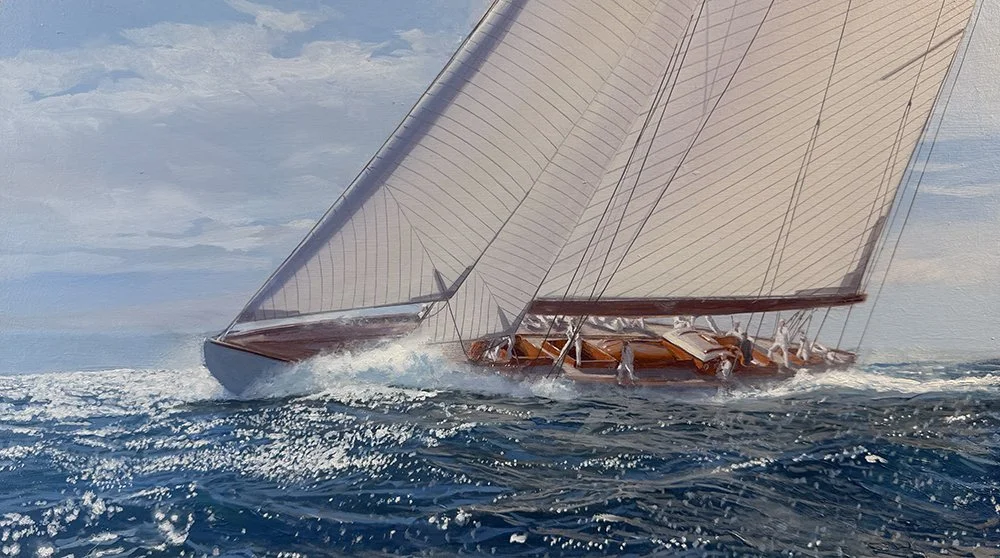
Launched on 7 May 1930, Whirlwind was one of four American J Class yachts built to defend the America's Cup against Sir Thomas Lipton's fifth and final challenger, Shamrock V.
Designed by L. Francis Herreshoff, son of the celebrated naval architect Nathanael Greene Herreshoff, she was built by George Lawley & Son at Neponset, Massachusetts, for a syndicate organised by Paul Hammond and Landon K. Thorne.
Whirlwind represented a radical departure from conventional America's Cup yacht design. Herreshoff explored the possibilities offered by the Universal Rule, producing a yacht with a long waterline, substantial displacement and a relatively modest sail area for her size.
Her distinctive pointed stern and sweeping underwater profile made her immediately recognisable amongst her contemporaries, Enterprise, Weetamoe and Yankee. With a waterline length of 86 feet, she remained the longest J Class yacht on the waterline until the construction of Ranger and Endeavour II in 1937.
Whirlwind differed considerably from the other three American contenders in both her construction and sail plan.
Whilst her rivals employed bronze hull plating over steel frames, Whirlwind was of composite construction, with double timber planking over a steel framework. Her substantial internal diagonal bracing provided longitudinal and torsional strength.
Her principal design features included:
A distinctive double-ended hull with a pointed canoe stern.
A long waterline and deep draught, designed with the prevailing winds and offshore conditions at Newport in mind.
Double-skin timber planking with a combined thickness of approximately 2½ inches.
A five-section bronze keel structure carrying external lead ballast.
A fixed keel without a centreboard.
An experimental two-headsail arrangement, dispensing with the conventional third headsail.
A permanent backstay and an innovative arrangement of forestays to support the mast.
Experimentation with lightweight duralumin mast construction.
Perhaps her most influential innovation was her simplified headsail arrangement. Although not fully exploited during her own racing career, the two-headsail rig anticipated developments subsequently adopted by other J Class yachts.
Herreshoff's exploration of greater waterline length also anticipated the larger and more powerful J Class designs that would emerge later in the decade.
Whirlwind began her trials in the spring of 1930, undertaking her first sail in New York waters on 2 June. During June she joined the other American contenders in the extensive programme of tuning-up races, which also included the former Cup yachts Resolute and Vanitie.
Although Whirlwind demonstrated considerable speed, particularly when reaching and sailing off the wind, she struggled to achieve consistent performance against her rivals when close-hauled. Difficulties with steering, sail handling and reliability hindered her campaign.
Nevertheless, contemporary race reports reveal several notable performances:
8 July 1930: Defeated Yankee by 7 minutes and 25 seconds after reaching a favourable change in wind direction ahead of her rival.
10 July 1930: Finished just 35 seconds behind Weetamoe.
4 August 1930: Finished only 12 seconds behind Enterprise and 32 seconds behind Yankee during the New York Yacht Club cruise from Newport to Mattapoisett.
5 August 1930: Led the fleet on both reaching legs of the race in Buzzards Bay before losing her advantage on the final windward leg.
Failures of her mainsail during the July observation races and again during the final August trials further compromised her chances of selection.
Enterprise was ultimately selected to defend the America's Cup, defeating Shamrock V in four consecutive races in September 1930.
Whirlwind's active racing career was brief, and she was eventually dismantled at City Island in 1935.
Although Whirlwind never competed in an America's Cup match, she occupies an important place in the development of the J Class.
Her combination of unconventional hull form, composite construction, extended waterline and experimental rig made her one of the most ambitious racing yachts of her generation.
Her significance lies as much in the ideas she introduced as in the races she sailed. Several of the principles explored by Herreshoff in 1930 would find greater success in subsequent generations of J Class yachts.
DesignerL. Francis Herreshoff
BuilderGeorge Lawley & SonBuilt at Neponset, Massachusetts
Launched 7 May 1930
Length overal l130 ft / 39.62 m
Waterline length 86 ft / 26.21 m
Beam 21 ft 9 in / 6.63 m
Draught 15 ft 6 in / 4.72 m
DisplacementApproximately 159 tons
Sail areaApproximately 7,535 sq ft / 700 m²
ConstructionDouble timber planking over steel framesRigBermudian sloop
Principal racing season1930
FateDismantled in 1935
Published dimensions and sail areas vary slightly between historical sources.
Whirlwind forms part of my ongoing J Class Project, exploring the history, design and racing careers of the extraordinary yachts that defined this remarkable period in sailing history.
Through extensive historical research, contemporary photographs, original race reports and paintings, the project seeks to bring their stories back to life.
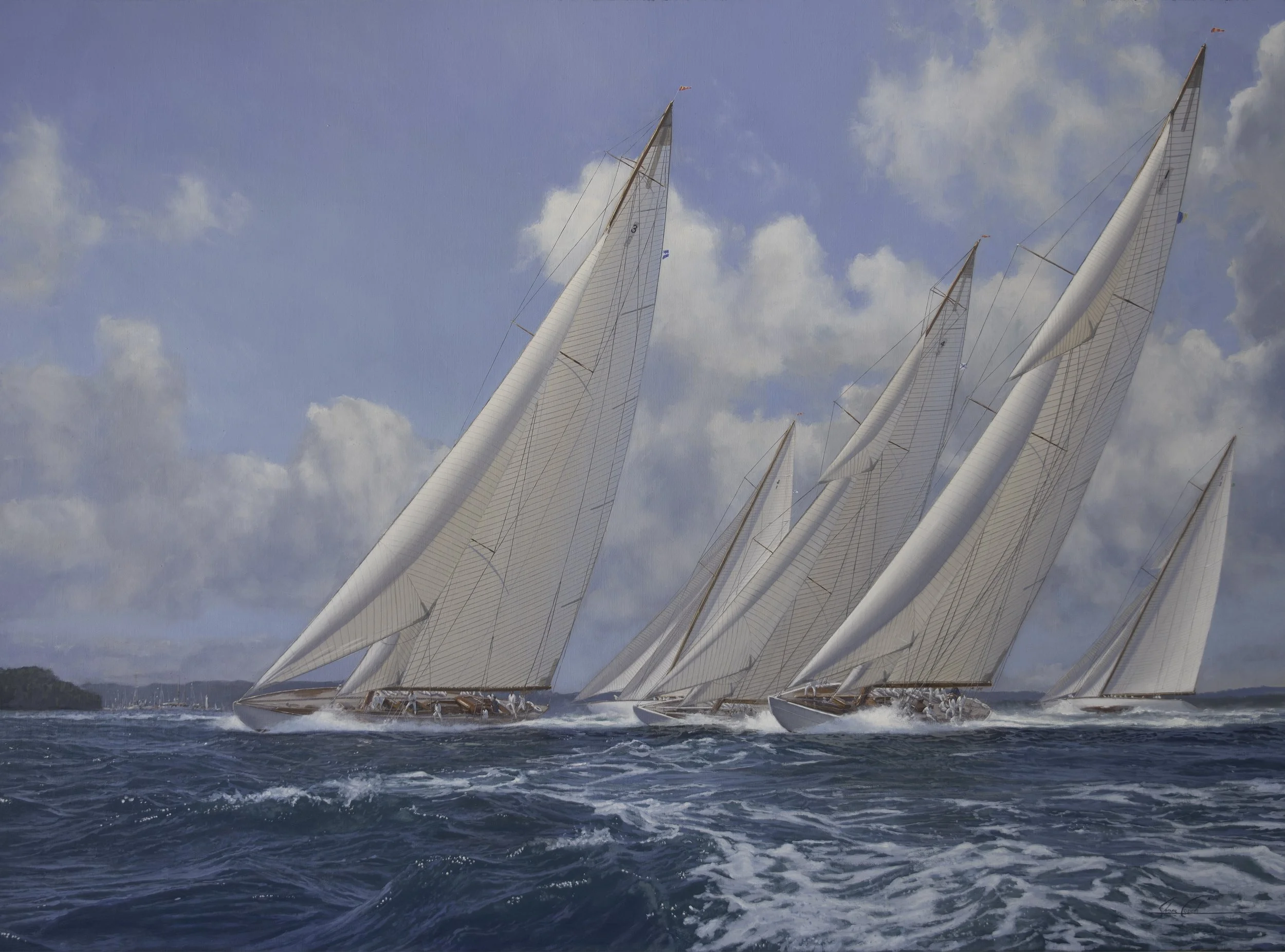
Explore my artistic interpretations of Whirlwind and her remarkable racing career
Seascape and Marine Artist