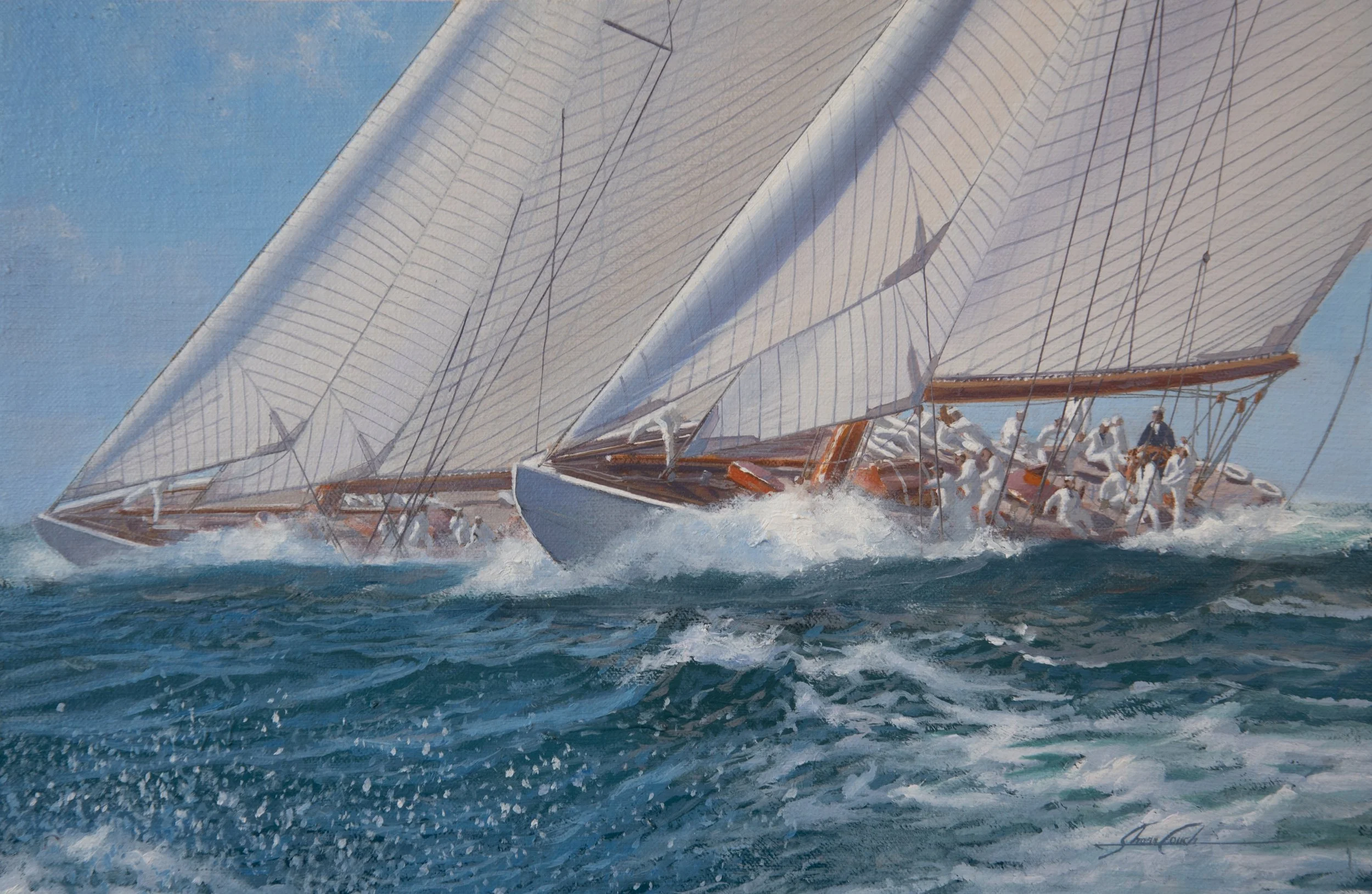
Weetamoe
J1 | 1930 | Clinton Hoadley Crane
Elegance, rivalry and continuous development.
History
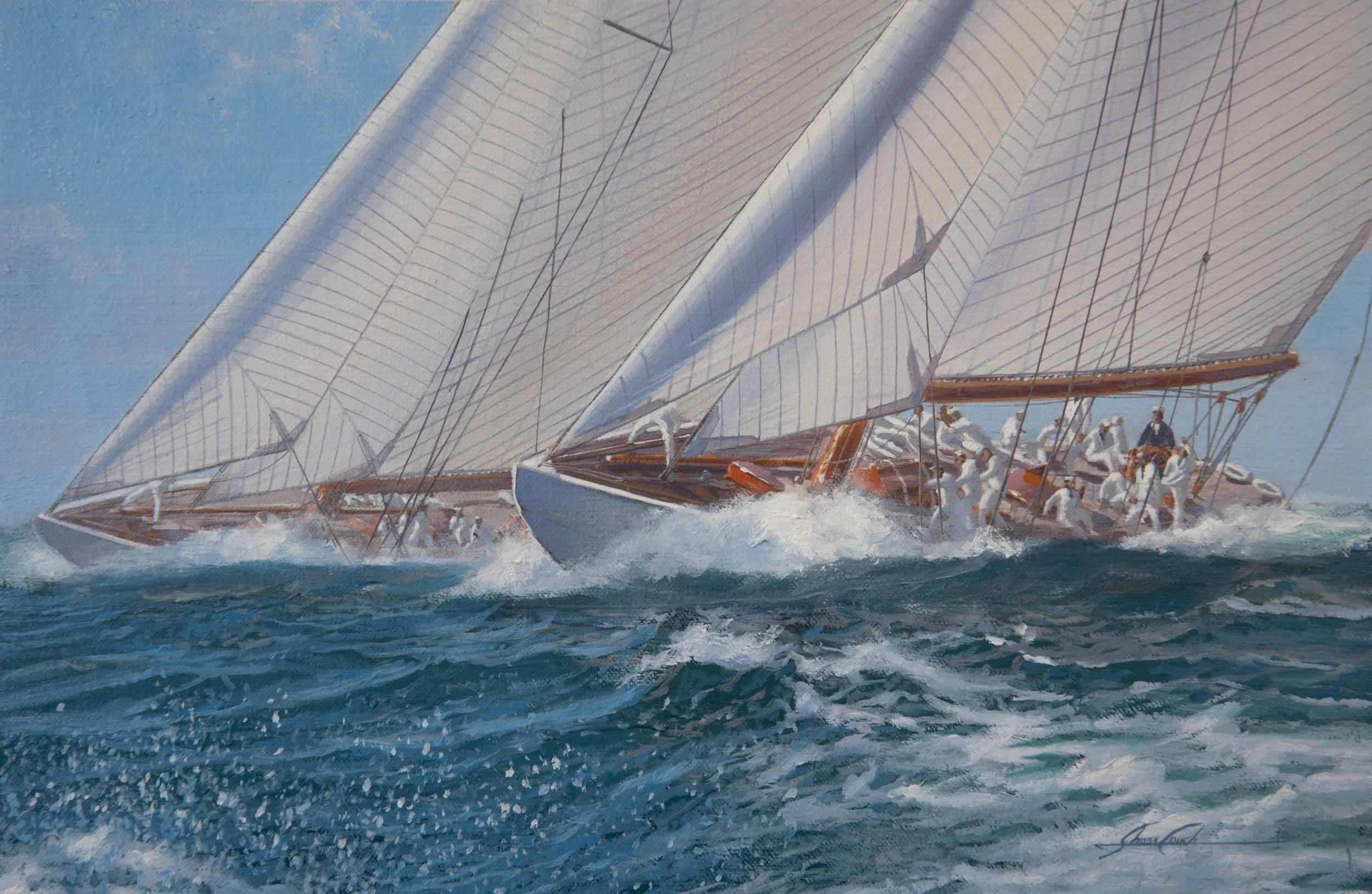
Launched on 10 May 1930, Weetamoe was one of four American J Class yachts built to defend the America's Cup against Sir Thomas Lipton's fifth and final challenger, Shamrock V.
Designed by Clinton Hoadley Crane and built by the Herreshoff Manufacturing Company at Bristol, Rhode Island, she was commissioned by a syndicate associated with J. P. Morgan, with George Nichols managing and helming the yacht during her 1930 campaign.
Distinguished by her slender hull, graceful sheer and distinctive underwater profile, Weetamoe represented a different interpretation of the Universal Rule from those of her contemporaries, Enterprise, Yankee and Whirlwind.
Throughout the summer of 1930, she emerged as one of Enterprise's most serious rivals. Although unsuccessful in securing the nomination to defend the America's Cup, Weetamoe continued racing and undergoing technical development throughout much of the decade.
Design and Technical Innovations
Weetamoe was the narrowest of the four American J Class yachts built for the 1930 America's Cup campaign.
Crane's design incorporated an unusually angular underwater profile, reducing wetted surface and offering the prospect of improved manoeuvrability. A centreboard passing through the lead keel provided additional lateral resistance when sailing to windward.
Her principal design features and technical developments included:
A comparatively narrow hull with a pronounced and graceful sheer.
Steel framing with Tobin bronze plating below the waterline and steel plating above.
A relatively triangular underwater profile.
A centreboard housed within the lead keel.
A hollow wooden mast and hollow boom in her original configuration.
Continued experimentation with mast construction, boom design and sail arrangements.
Alterations to the mast position and rigging during the intervening racing seasons.
A lightweight duralumin mast fitted for the 1934 campaign.
One of the most significant developments in Weetamoe's career came in 1934, when her underwater profile was substantially modified in an attempt to improve stability and performance.
Her lead ballast was recast and the keel configuration altered to incorporate a bulb, lowering the centre of gravity. Contemporary reports anticipated a considerable improvement in stability.
The modifications did not deliver the expected improvement in overall racing performance, however, and the experimental keel changes were subsequently reversed.
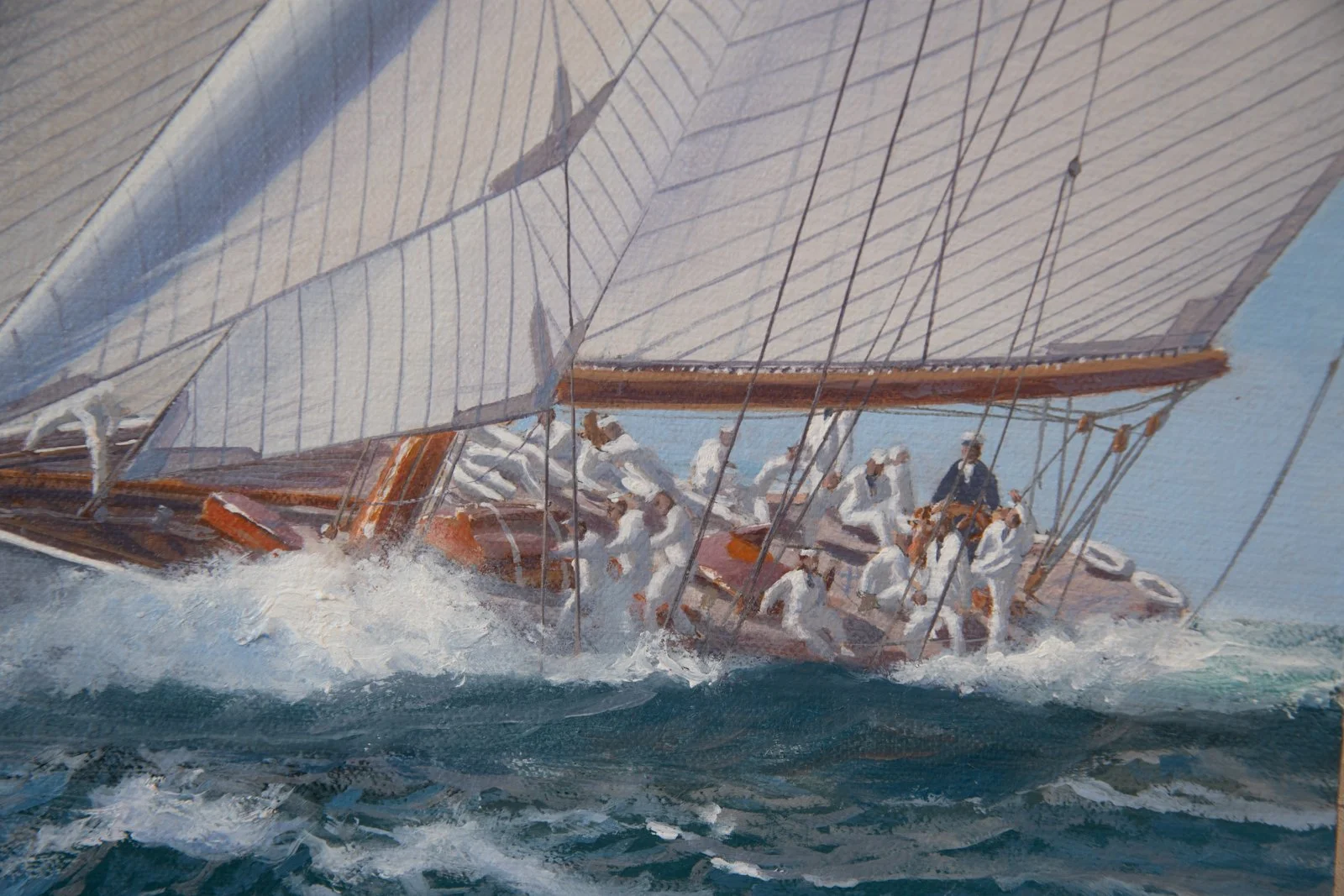
Detail from an original oil painting by Shane Couch oil on panel 8×12inches
Racing Career
1930 – America's Cup Defender Trials
Weetamoe quickly established herself as a formidable competitor during the early summer races of 1930.
Her performances during June and July demonstrated that Enterprise's eventual selection as the defender was far from inevitable.
Among her notable performances were:
16 June 1930: Defeated Enterprise by 1 minute and 13 seconds.
17 June 1930: Defeated Enterprise by 54 seconds, recording her third successive victory.
7 July 1930: Defeated Whirlwind by 3 minutes and 32 seconds.
8 July 1930: Defeated Enterprise by just 26 seconds in a closely contested observation race.
10 July 1930: Defeated Whirlwind by 35 seconds, continuing her successful series of July races.
Despite these encouraging performances, Enterprise demonstrated greater consistency during the final August trials and was selected to defend the America's Cup.
1931–1933 – Keeping the Competition Alive
Following the 1930 campaign, Weetamoe was acquired by Frederick H. Prince, who continued to race her during the intervening years between America's Cup challenges.
With several of the original American J Class yachts out of commission, Weetamoe's frequent encounters with the older racing yacht Vanitie helped sustain American big-yacht racing.
She won the prestigious King's Cup in both 1931 and 1932.
These seasons also provided valuable opportunities to experiment with spars, sail plans, rigging and sail handling, contributing to her preparations for the next America's Cup challenge.
1934 – A Second America's Cup Campaign
With the arrival of T. O. M. Sopwith's British challenger Endeavour, Weetamoe returned to competition for the nomination to defend the America's Cup.
Substantially modified and fitted with a duralumin mast, she faced the extensively developed Yankee and the newly constructed Rainbow, designed by W. Starling Burgess.
Despite the considerable investment in her development, Weetamoe was unable to reproduce the competitive form she had demonstrated in 1930.
Rainbow was eventually selected to defend the Cup.
1935–1938 – The Closing Years
Weetamoe was laid up in 1935 before returning to American racing in 1936 under the ownership of Chandler Hovey.
She did not participate in the 1937 America's Cup defender trials, and some of her equipment subsequently passed to Rainbow.
Weetamoe was dismantled in the late 1930s, bringing to an end the career of one of the most distinctive yachts of the original J Class fleet.
Historical Significance
Although Weetamoe never competed in an America's Cup match, her contribution to the development of the J Class extended far beyond the defender trials of 1930 and 1934.
Her continued racing during the intervening years helped maintain American big-yacht competition, whilst her evolving rig and experimental underwater configuration reflected the relentless pursuit of improved performance that characterised the J Class era.
Her close rivalry with Enterprise in 1930 remains one of the most compelling stories of the opening season of J Class racing.
Principal Dimensions and Specifications
Designer Clinton Hoadley Crane
Builder Herreshoff Manufacturing Company
Built atBristol, Rhode Island, USA Yard number1147
Launched 10 May 1930
Original ownership Morgan–Nichols syndicate Later ownersFrederick H. Prince and Chandler Hovey
Length overall 125 ft 9 in / 38.33 m
Waterline length 83 ft / 25.30 m
Beam 20 ft 3 in / 6.17 mDraught15 ft / 4.57 m
Displacement Approximately 146.6 metric tonnes
Sail area 7,335 sq ft / 681.4 m²
Construction Steel framing with bronze and steel hull plating
Career America's Cup defender trials1930 and 1934
Fate Dismantled in the late 1930s, commonly dated 1938
Published dimensions and sail areas vary between historical sources and according to the yacht's configuration at different stages of her racing career.
The J Class Project
Weetamoe forms part of my ongoing J Class Project, exploring the history, design and racing careers of the extraordinary yachts that defined this remarkable period in sailing history.
Through extensive historical research, contemporary photographs, original race reports and paintings, the project seeks to bring their stories back to life.
Weetamoe in Paintings
Explore my artistic interpretations of Weetamoe and her remarkable racing career