Rainbow
J4/J5 | 1934 & 2012 | W. Starling Burgess
An America's Cup champion reborn.
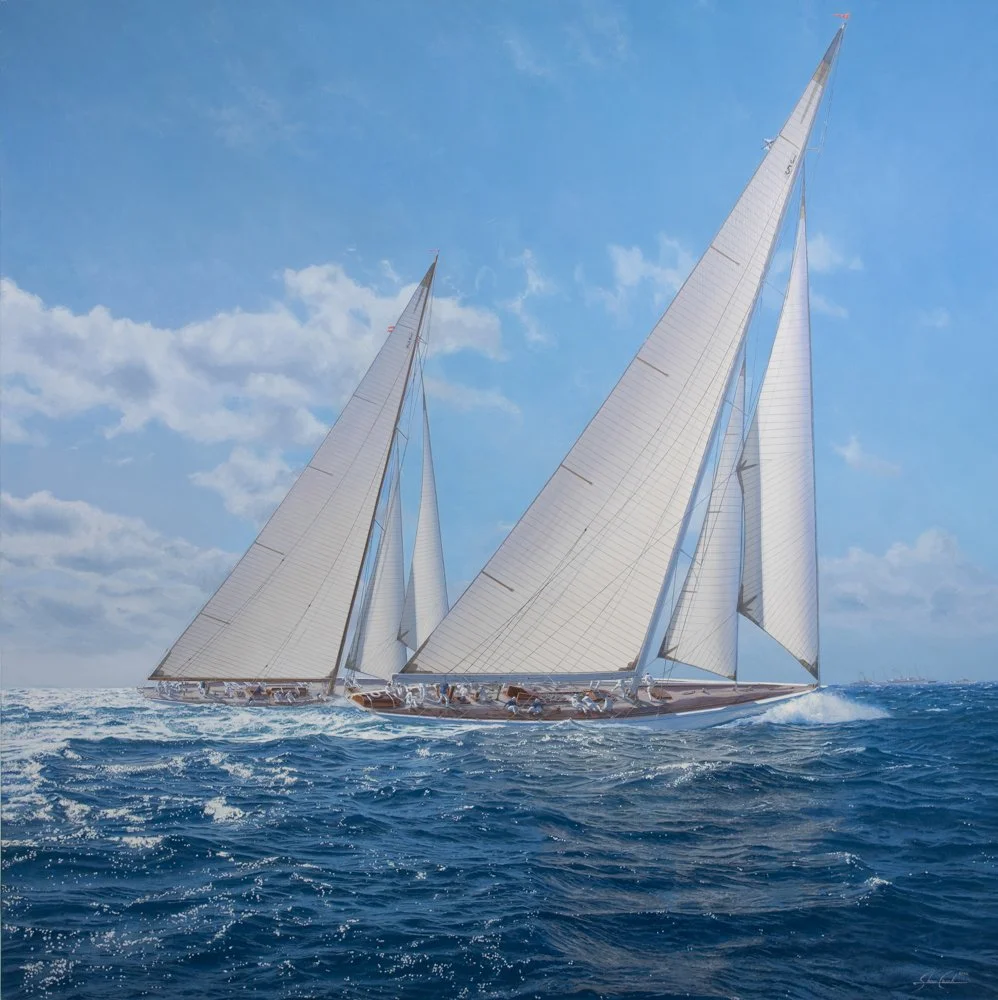
Battle for defense Rainbow vs Yankee oil on canvas 60×60 inches
History
Launched on 15 May 1934, Rainbow was designed by W. Starling Burgess and built by the Herreshoff Manufacturing Company at Bristol, Rhode Island, to defend the America's Cup against the British challenger Endeavour.
Harold Stirling Vanderbilt, having successfully defended the Cup aboard Enterprise in 1930, organised a syndicate to finance the construction of a new yacht.
Burgess had already undertaken design work for a prospective challenger following the 1930 campaign. This provided a foundation for Rainbow, enabling her to be constructed in the remarkably short period of just 100 days.
Drawing on the experience gained with Enterprise, Burgess developed a yacht incorporating refined hull lines, advanced sail-handling equipment and significant improvements in rig construction.
Rainbow would go on to secure one of the most closely contested and memorable victories in America's Cup history.
Design and Technical Innovations
Rainbow represented a further stage in the development of the American J Class yacht.
Her hull was two feet longer on the waterline than Enterprise, whilst her forward sections incorporated greater flare, providing a wider working deck and helping to reduce the amount of water coming aboard.
Changes to the rules governing the America's Cup required greater provision for crew accommodation below deck. Consequently, much of the mechanical sail-handling equipment previously housed below deck aboard Enterprise was repositioned on deck.
Rainbow's principal design features and technical innovations included:
Steel framing with bronze hull plating below the waterline and steel plating above.
Flush underwater plating seams to minimise resistance.
Increased flare in the forward sections to improve deck working conditions.
A lightweight duralumin mast.
High-tensile steel rod rigging in place of conventional wire shrouds, reducing windage and weight aloft.
An innovative masthead hook that supported the hoisted mainsail and reduced compression loads associated with the main halyard.
A centreboard to provide additional lateral resistance when sailing to windward.
The wide Park Avenue boom, transferred from Enterprise during the summer of 1934.
Continued experimentation with headsail design, including a double-clewed jib.
The Park Avenue boom allowed the crew to adjust the curvature of the foot of the mainsail, providing greater control over its aerodynamic shape.
These developments reflected the increasingly scientific approach to yacht design and sail performance that characterised the America's Cup during the 1930s.

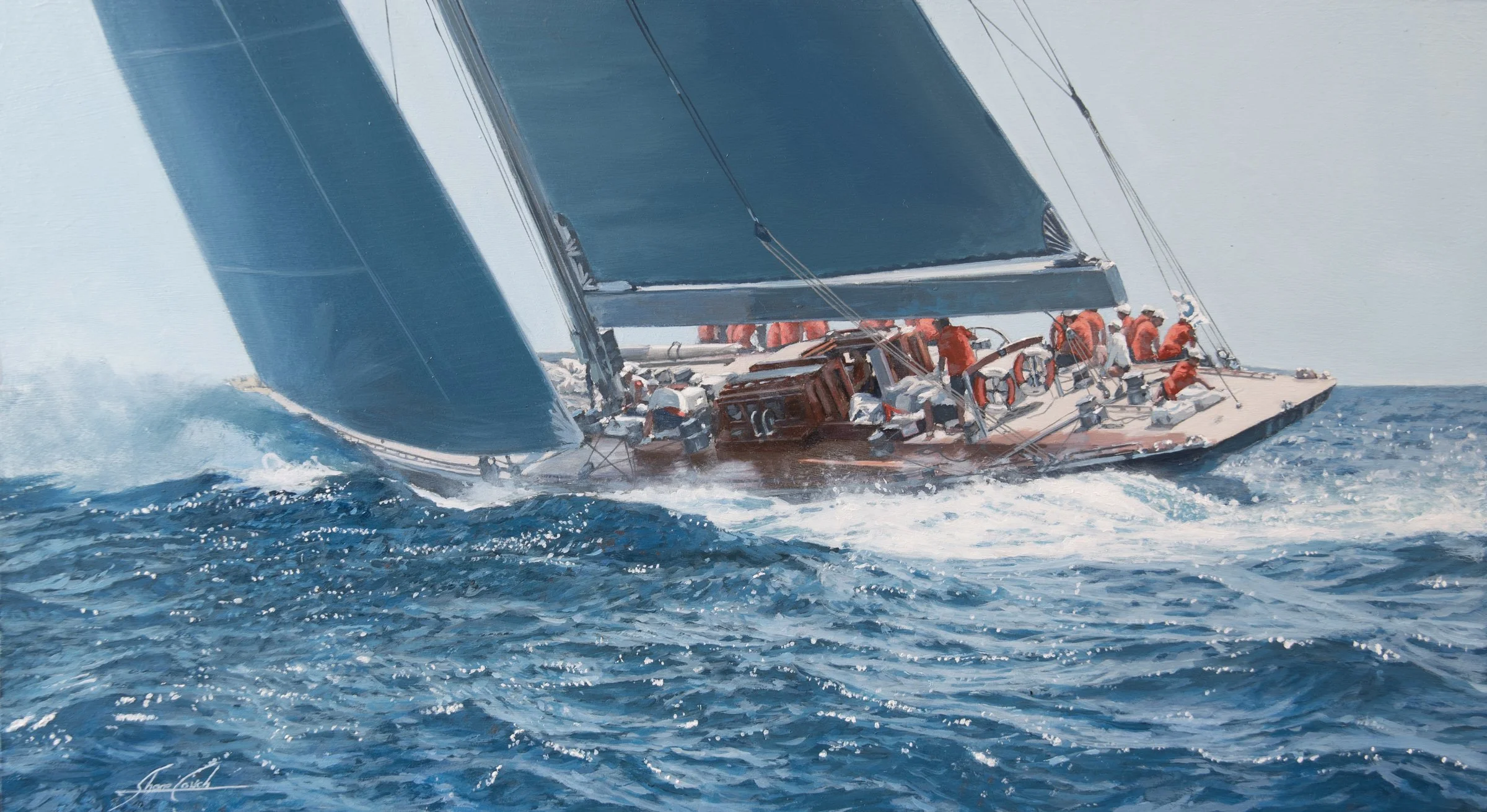
Rainbow racing Yankee detail 1934
Racing Career
1934 – Selecting the Defender
Rainbow faced considerable competition from the extensively modified Yankee and Weetamoe during the American defender trials.
Yankee, sailed by Charles Francis Adams, proved particularly competitive during the early part of the season, demonstrating that the newly constructed Rainbow would not automatically secure the nomination.
Rainbow's performance improved as her campaign progressed, with Vanderbilt and his crew refining her rig, sail combinations and handling.
Victories in the Astor Cup and King's Cup demonstrated her developing potential, and she was eventually selected to defend the America's Cup.
1934 – The America's Cup
Rainbow's opponent was Endeavour, designed by Charles E. Nicholson for the British aviation manufacturer and experienced yachtsman T. O. M. Sopwith.
Sopwith brought considerable technical knowledge and resources to his challenge, applying principles of aerodynamics and aircraft construction to the development of his yacht and her sails.
Endeavour demonstrated her exceptional speed by winning the first two races of the series, placing the American defence under considerable pressure.
Vanderbilt and his experienced afterguard responded with determined sailing, careful tactical decisions and highly coordinated sail handling.
Rainbow won the following four races to retain the America's Cup by four victories to two.
The series was amongst the most closely fought of the J Class era, featuring intense tactical encounters and controversy over racing rules.
For many observers, Endeavour had demonstrated remarkable outright speed, but Rainbow's preparation, crew work and tactical execution ultimately secured the victory.
1937 – The Final J Class America's Cup Campaign
Following her successful defence, Rainbow was laid up before being prepared for a return to competition in 1937.
Acquired by Chandler Hovey, she competed against the extensively developed Yankee and Vanderbilt's newly constructed Ranger for the nomination to defend the America's Cup against Endeavour II.
Ranger represented a further evolution of J Class design, exploiting the maximum permitted waterline length and incorporating the results of extensive model testing.
Rainbow was unable to match Ranger's performance, but continued racing during the final season of the original J Class era.
She was amongst the five J Class yachts that gathered in American waters during the summer of 1937, alongside Yankee, Ranger, Endeavour and Endeavour II.
Rainbow was sold for scrap in 1940, bringing her original racing career to an end.
Historical Significance
Rainbow occupies a distinguished place in the history of the America's Cup.
Her victory in 1934 demonstrated that success depended not simply upon the speed of the yacht, but upon the integration of design, preparation, sail development, crew coordination and tactical judgement.
She secured the second of Harold Vanderbilt's three successful J Class America's Cup defences, following Enterprise in 1930 and preceding Ranger in 1937.
Her rivalry with Endeavour remains one of the defining stories of the Golden Age of yacht racing.
Principal Dimensions and Specifications – Rainbow 1934
Class: J Class – Universal Rule
Racing number: J5 (1934 campaign)
Nationality: American
Designer: W. Starling Burgess
Builder: Herreshoff Manufacturing Company
Built at: Bristol, Rhode Island, USA
Launched: 15 May 1934
Original ownership: Harold Stirling Vanderbilt syndicate
Later owner: Chandler Hovey
Length overall: 126.65 ft / 38.60 m
Waterline length: 82 ft / 24.99 m
Beam: 20.92 ft / 6.38 m
Draught: 14.9 ft / 4.54 m, excluding centreboard
Displacement: Approximately 138 tons
Measured sail area: 7,555 sq ft / 701.9 m²
Construction: Steel framing with bronze and steel hull plating
Rig: Bermudian sloop
America's Cup victory: 1934
Fate: Sold for scrap in 1940
Principal dimensions are taken from the contemporary technical particulars published in Scientific American in September 1934. Figures vary slightly between historical sources.
Rainbow Reborn – 2012
More than seven decades after the loss of the original Rainbow, her distinctive lines returned to the water with the construction of a modern J Class yacht.
Designed by Dykstra Naval Architects and launched by Holland Jachtbouw in the Netherlands in 2012, the new Rainbow was based upon Burgess's original 1934 hull design, adapted to the requirements of contemporary J Class racing.
Her aluminium hull, carbon-fibre rig, modern sail-handling systems and innovative hybrid propulsion system brought twenty-first-century technology to a yacht inspired by the Golden Age of sailing.
Although retaining the character and elegance of her predecessor, the modern Rainbow is a newly constructed yacht rather than a restoration of the original vessel.
She competed regularly on the international J Class racing circuit following her launch, including the Mediterranean racing season of 2014.
Her return to competitive sailing illustrates the enduring appeal of the J Class and the remarkable marriage of traditional yacht design with modern engineering.
Rainbow Palma Superyacht Cup 2014
Principal Dimensions – Rainbow 2012
Class: Modern J Class
Naval architects: Dykstra Naval Architects
Original design: W. Starling Burgess
Builder: Holland Jachtbouw, Netherlands
Launched: 2012
Length overall: Approximately 39.95 m / 131 ft
Beam: Approximately 6.37 m / 20 ft 11 in
Draught: Approximately 4.9 m / 16 ft 1 in
Displacement: Approximately 176 metric tonnes
Hull construction: Aluminium
Rig: Bermudian sloop with carbon-fibre spars
The J Class Project
Rainbow forms part of my ongoing J Class Project, exploring the history, design and racing careers of the extraordinary yachts that defined this remarkable period in sailing history.
Through extensive historical research, contemporary photographs, original race reports and paintings, the project seeks to bring their stories back to life.
The revival of the J Class provides a remarkable opportunity to experience something of the power, elegance and spectacle of these yachts in modern waters.
Rainbow in Paintings
Explore my artistic interpretations of Rainbow and her remarkable racing career