Endeavour
JK4 | 1934 | Charles E. Nicholson
The challenger that came so close.
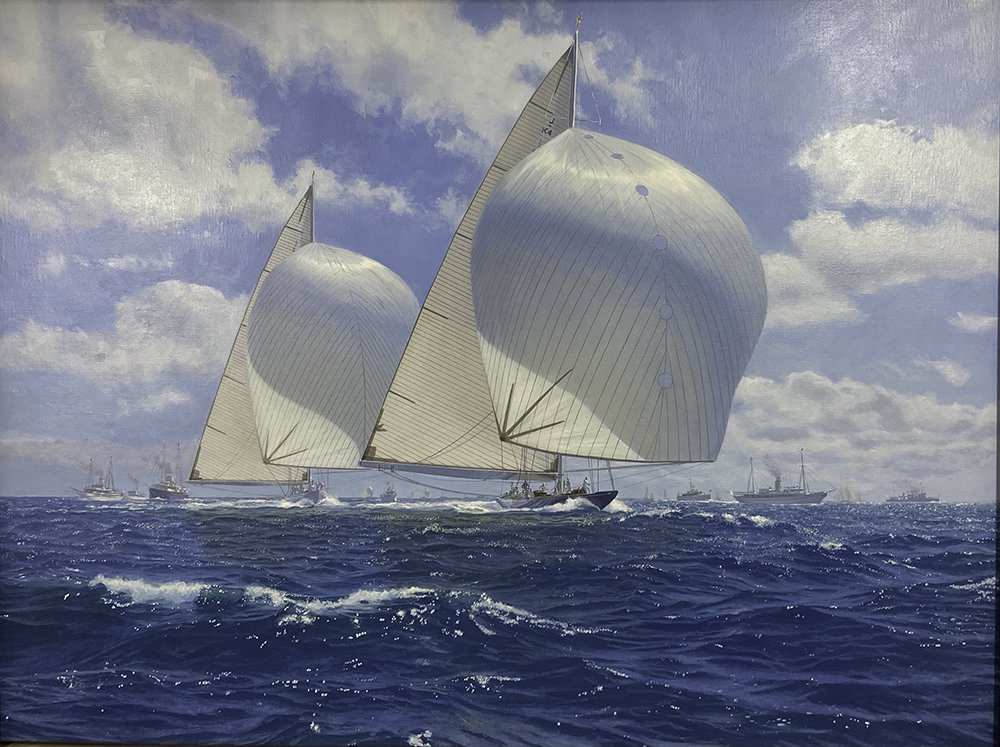
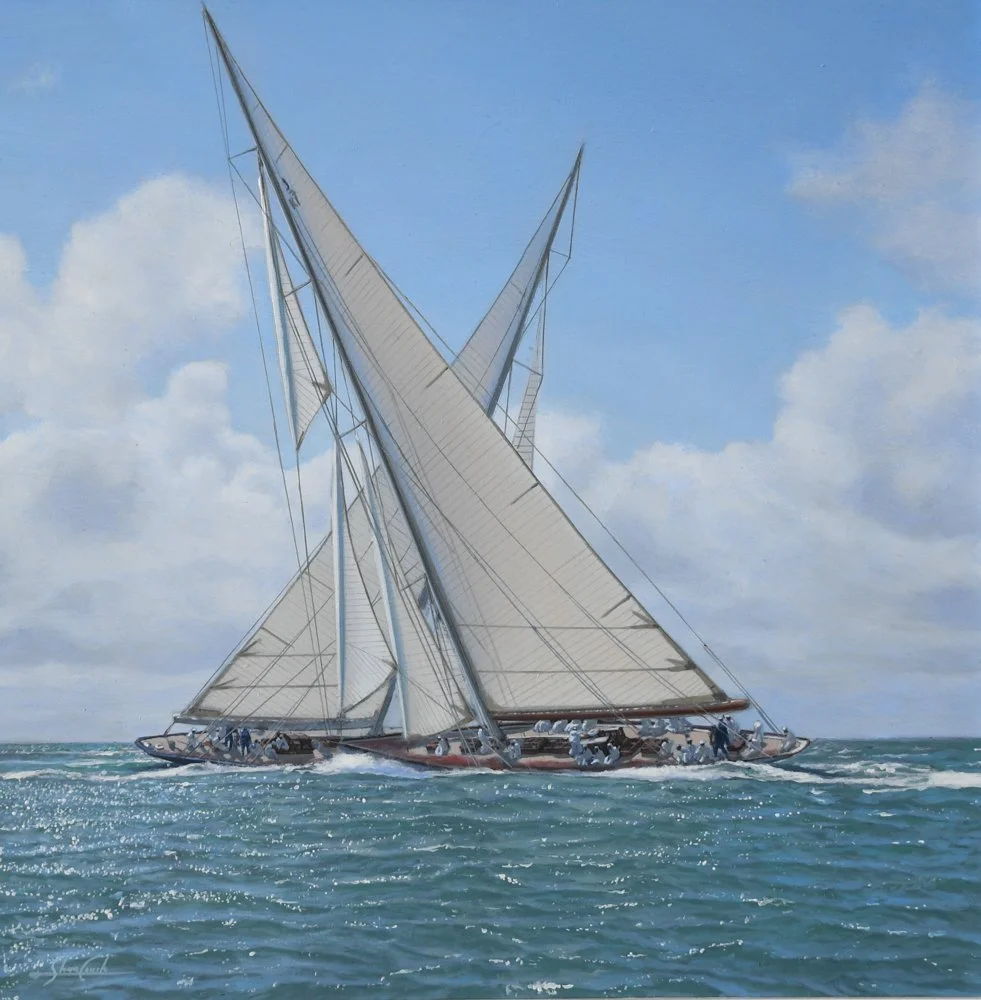
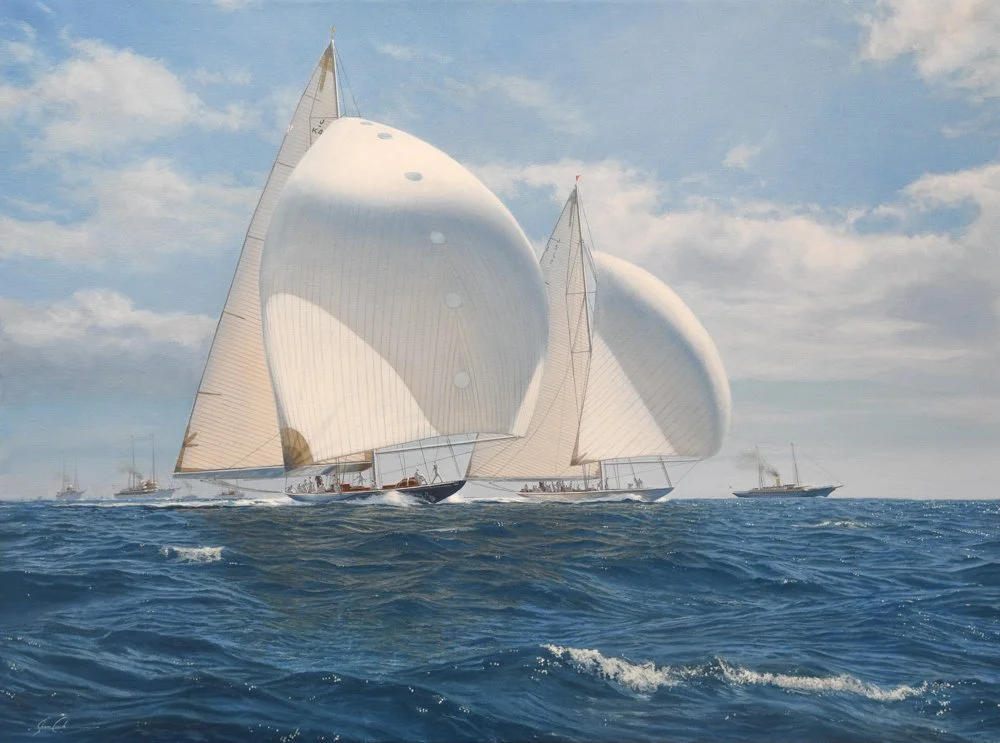
She is the faster boat oil on canvas 30×40inches
History
Launched at Gosport in April 1934, Endeavour was designed by Charles E. Nicholson and built by Camper & Nicholsons for the British aviation manufacturer and accomplished yachtsman T. O. M. Sopwith.
Having acquired Sir Thomas Lipton's former challenger Shamrock V, Sopwith had gained considerable experience racing J Class yachts in British waters before mounting his own challenge for the America's Cup.
His knowledge of aerodynamics, engineering and aircraft construction brought a new dimension to British preparations for the Cup.
Endeavour was Nicholson's third purpose-built J Class yacht, following Shamrock V in 1930 and Velsheda in 1933. Drawing upon the experience gained with these earlier yachts, Nicholson produced a powerful and elegant racing yacht that would prove exceptionally competitive against her American rivals.
With her distinctive blue hull and imposing sail plan, Endeavour became one of the most celebrated racing yachts of her generation.
Design and Technical Innovations
Endeavour represented a sophisticated combination of traditional naval architecture and contemporary engineering.
Her steel hull incorporated flush underwater plating, providing a smooth surface intended to minimise resistance. Her lightweight steel mast employed welded construction with internal reinforcement, reflecting Sopwith's experience in the aviation industry.
Considerable attention was devoted to sail shape, aerodynamic efficiency, rigging and weight distribution.
Her principal design features and technical developments included:
A steel hull with flush underwater plating.
A hollow, welded steel mast incorporating internal reinforcement.
Specialised mast fittings and rigging developed with assistance from Sopwith's engineering resources.
A retractable centreboard providing additional lateral resistance when sailing to windward.
An experimental quadrilateral jib with separate upper and lower sheets.
Extensive experimentation with alternative headsail arrangements.
Development of large downwind sails, including the experimental ventilated spinnaker known as Annie Oakley.
Continued experimentation with ballast, boom construction and sail shape.
The quadrilateral jib was particularly distinctive. Its four-cornered shape and separate sheets allowed greater control over the distribution of sail area and the shape of the sail.
Endeavour's preparations also included experiments with different centreboard positions and the removal of approximately two tons of lead ballast to improve performance in lighter conditions.
The continual refinement of her rig and sail plan illustrates the increasingly scientific approach to competitive yacht design during the 1930s.
Racing Career
1934 – The British Racing Season
Endeavour made an immediate impression during her opening races in British waters.
Her performances at Harwich demonstrated considerable power in fresh conditions, whilst subsequent races on the Thames, in the Solent and along the south coast provided opportunities to assess her performance in a wider range of wind and sea conditions.
Velsheda became her principal rival during the preparations for the America's Cup. Their encounters provided valuable opportunities to experiment with sail combinations, ballast, centreboard settings and starting tactics.
The British season also brought Endeavour into competition with the celebrated older racing yachts Britannia and Astra, together with Sopwith's former yacht Shamrock V.
Her 1934 British fleet-racing record included eight first prizes and three second prizes from twelve races.
The final trials in Torbay during July demonstrated the considerable potential of Nicholson's design.
However, a dispute with members of her professional crew shortly before her departure for America forced Sopwith to recruit a number of amateur replacements. The interruption to crew training and competitive preparation presented an additional challenge ahead of the America's Cup.
1934 – The America's Cup
Endeavour's opponent at Newport, Rhode Island, was Rainbow, designed by W. Starling Burgess and sailed by Harold Stirling Vanderbilt.
After the abandonment of the first attempted race through lack of wind, Endeavour demonstrated her exceptional speed by winning the opening two completed races.
The results of the series were:
17 September: Endeavour won by 2 minutes and 9 seconds.
18 September: Endeavour won by 51 seconds.
20 September: Rainbow won.
22 September: Rainbow won.
24 September: Rainbow won.
25 September: Rainbow won, retaining the America's Cup.
The subsequent races featured intense tactical encounters, controversial incidents and disagreements concerning racing rules and protests.
Despite Endeavour's early advantage, Vanderbilt and his experienced crew recovered to win four consecutive races.
The final result was four victories to two in Rainbow's favour.
Endeavour's challenge nevertheless remains one of the most memorable British attempts to win the America's Cup during the J Class era.
1935 – Return to British Waters
Following her return from America, Endeavour resumed racing in the British big-yacht fleet.
The 1935 season was particularly significant because of the visit of the American J Class yacht Yankee, bringing the transatlantic rivalry into British waters.
Endeavour continued to compete against Velsheda, Shamrock V and the other yachts of the British fleet.
Among her notable successes was victory in the King's Cup at Cowes on 6 August 1935.
These encounters maintained the spirit of international competition between America's Cup challenges and provided some of the finest spectacles of British yacht racing.
1936 – The Arrival of Endeavour II
Determined to mount another challenge for the America's Cup, Sopwith commissioned a new yacht from Charles E. Nicholson.
Launched in June 1936, Endeavour II exploited the greater waterline length permitted under the Universal Rule and incorporated further developments in hull design and rig construction.
The original Endeavour continued racing in British waters, competing against the new yacht and the established members of the fleet.
The presence of both Endeavours provided a fascinating comparison between two successive generations of Nicholson's J Class designs.
1937 – The Final Season of the Original J Class Era
Endeavour returned to American waters in 1937, accompanying Endeavour II and providing valuable comparative racing during preparations for Sopwith's second America's Cup challenge.
By this time, the original yacht was owned by H. A. Andreae and chartered to Frederick Sigrist.
Although Endeavour II was selected to challenge Ranger, the original Endeavour continued to participate in the wider American racing programme.
The gathering of Endeavour, Endeavour II, Yankee, Rainbow and Ranger during the summer of 1937 represented the culmination of the original J Class racing era.
Never before had the development of these extraordinary racing yachts been demonstrated on such a scale.
Decline, Rescue and Restoration
With the decline of big-yacht racing and the approaching Second World War, Endeavour's competitive career came to an end.
During the following decades, the yacht passed through successive ownerships and fell into considerable disrepair. Various attempts were made to save her, but for many years her future remained uncertain.
In 1984, American yachtswoman Elizabeth Meyer acquired the deteriorating yacht and embarked upon an ambitious five-year restoration.
Initial reconstruction work was undertaken at Calshot on Southampton Water before the yacht was transferred to the Royal Huisman shipyard in the Netherlands, where the restoration was completed in collaboration with Dykstra Naval Architects.
Endeavour was relaunched on 22 June 1989, returning to sail for the first time in 52 years.
The restoration represented far more than the rescue of an individual yacht. It helped stimulate renewed interest in the preservation and reconstruction of the great J Class yachts.
The Revival of J Class Racing
In September 1989, Endeavour raced against Shamrock V at Newport, Rhode Island, bringing the spectacle of J Class competition back to American waters.
In 1999, Endeavour, Shamrock V and Velsheda came together at the Antigua Classic Yacht Regatta, reuniting the three surviving original J Class yachts.
Their reunion marked an important turning point in the revival of the class and encouraged the construction of new yachts based upon the original designs of the 1930s.
Endeavour subsequently underwent further technical development, including a major refit completed in 2011 by Yachting Developments in New Zealand.
Modern rig construction, sail-handling systems and engineering equipment allowed the yacht to participate in contemporary J Class racing whilst preserving the character of Nicholson's original design.
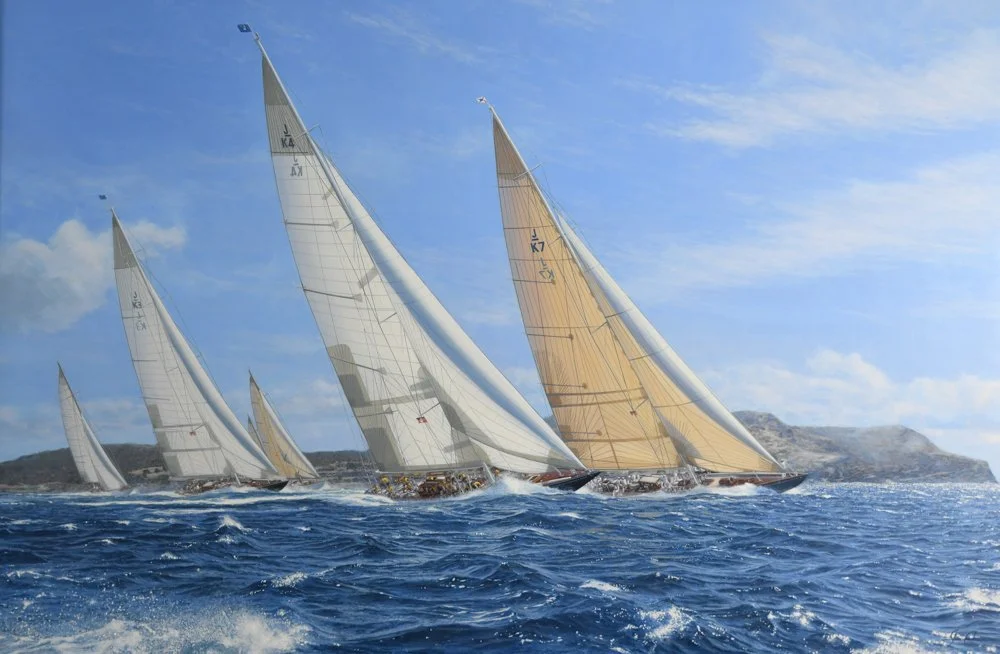
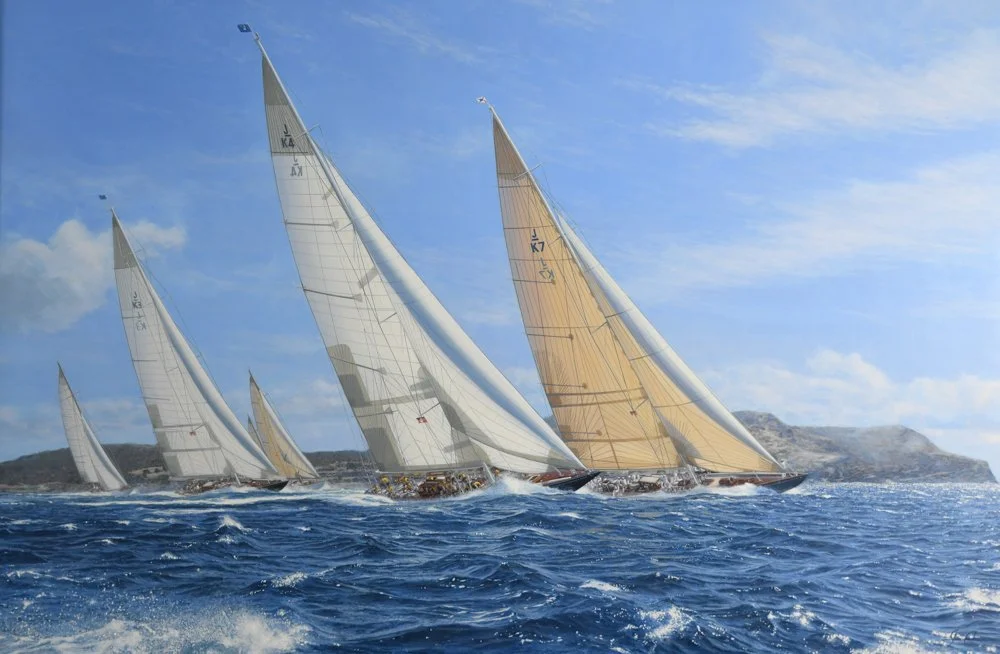
Return of the Js Endevour racing Velsheda and Shamrock Antigua 1999. Oil on canvas 40×60inches
Historical Significance
Endeavour occupies a unique place in the history of the J Class.
Her 1934 America's Cup campaign demonstrated the remarkable potential of British yacht design, engineering and sail development, whilst her subsequent racing career contributed to the extraordinary spectacle of the final years of the original J Class era.
More than half a century later, her restoration helped inspire a renaissance of the very class she had once helped define.
Her story is therefore not simply one of an America's Cup challenge, but of innovation, sporting ambition, survival and rebirth.
Principal Dimensions and Specifications – 1934
Class: J Class – Universal Rule
Racing number: JK4
Nationality: British
Designer: Charles E. Nicholson
Builder: Camper & Nicholsons
Built at: Gosport, Hampshire, England
Launched: April 1934
Original owner: T. O. M. Sopwith
Length overall: Approximately 130 ft / 39.62 m
Waterline length: 83 ft / 25.30 m
Beam: 22 ft / 6.71 m
Draught: Approximately 15 ft / 4.57 m, excluding centreboard
Displacement: Approximately 143 tons
Measured sail area: Approximately 7,550 sq ft / 701.4 m²
Hull construction: Steel
Original rig: Bermudian sloop with steel mast
America's Cup challenge: 1934
Restored: 1984–1989
Relaunched: 22 June 1989
Status: Surviving original J Class yacht
Principal dimensions refer to contemporary published particulars from 1934. Measurements vary between historical sources and later configurations.
The J Class Project
Endeavour forms part of my ongoing J Class Project, exploring the history, design and racing careers of the extraordinary yachts that defined this remarkable period in sailing history.
Through extensive historical research, contemporary photographs, original race reports and paintings, the project seeks to bring their stories back to life.
Her association with the Solent, the waters in which I have spent much of my life observing and painting the sea, makes Endeavour a particularly meaningful subject within the collection.
Endeavour in Paintings
Explore my artistic interpretations of Endeavour and her remarkable racing career